
Teen Patti Sequence: Hand Rankings Chart & Full List
Every Teen Patti pot is settled by one ladder of six hands, and every argument about that ladder is settled by the run order inside it. This page puts both on a single chart: the six hand types ranked from Trail down to High Card with their exact odds, plus the complete 3 Patti sequence list — all twelve runs from A-K-Q down to 4-3-2. The chart is free to download as a printable PDF, so you can keep it next to the table (or under your phone) until the order is automatic.
The Teen Patti sequence chart

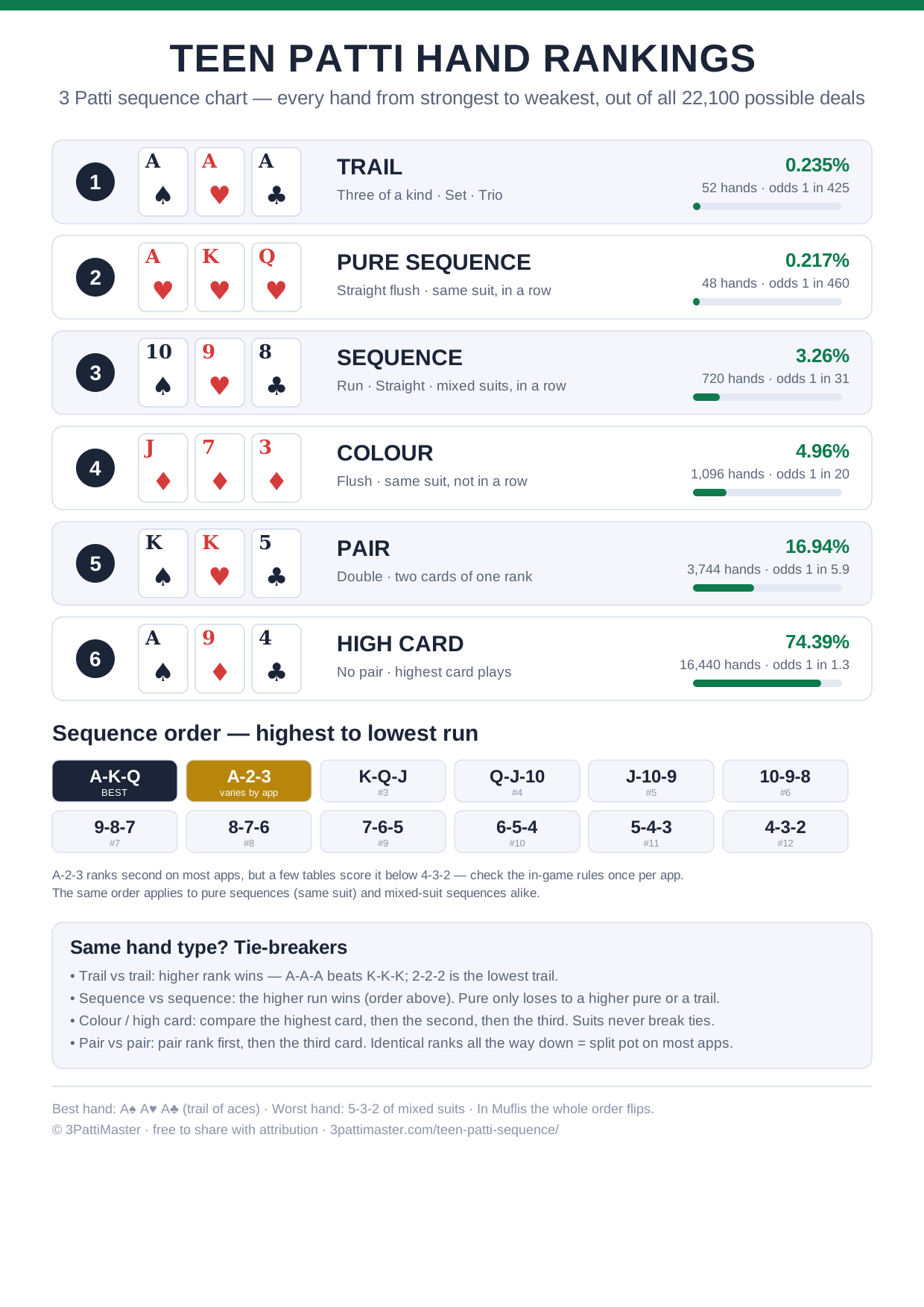
Free, no sign-up. Share or embed it anywhere with a link back to this page — see sharing & attribution.
The six hands, highest to lowest
Teen Patti (3 Patti — same game, different spelling) uses exactly six hand types. Out of a 52-card deck there are 22,100 possible three-card hands, so the frequency of each type is a count, not an estimate:
| Rank | Hand | What it is | Example | Chance | Odds |
|---|---|---|---|---|---|
| 1 | Trail (Set / Trio) | Three cards of the same rank | A♠ A♥ A♣ | 0.24% | 1 in 425 |
| 2 | Pure Sequence | Run of three, all one suit | A♥ K♥ Q♥ | 0.22% | 1 in 460 |
| 3 | Sequence (Run) | Run of three, mixed suits | 10♠ 9♥ 8♣ | 3.26% | 1 in 31 |
| 4 | Colour (Flush) | One suit, not in a row | J♦ 7♦ 3♦ | 4.96% | 1 in 20 |
| 5 | Pair | Two cards of one rank | K♠ K♥ 5♣ | 16.94% | 1 in 5.9 |
| 6 | High Card | None of the above | A♠ 9♦ 4♣ | 74.39% | 1 in 1.3 |
Two things on this table decide more pots than anything else. First, a pair already beats about three-quarters of all possible hands — 74% of deals are plain high card, so folding every pair on reflex is the most expensive habit a beginner can have. Second, the top of the ladder is genuinely rare: everything above a sequence appears less than once in 200 deals, so a player representing a trail usually doesn't have one. If you want the full probability breakdown — including why the pure sequence is actually rarer than the trail that outranks it — that deep-dive lives in our Teen Patti hierarchy guide.
The full 3 Patti sequence list, in order
“Sequence” questions cause more table disputes than any other rule, because two separate orders are in play: where sequences sit on the six-hand ladder, and how the twelve possible runs rank against each other. The ladder is above; here is the run order, highest first:
This one list settles every sequence-versus-sequence showdown, pure or mixed. When two runs meet, the higher one on this list wins; suits never break the tie. If both players hold the same run in mixed suits, the pot is split on most apps.
The only entry that genuinely differs between apps is A-2-3. The ace plays at both ends of a run — A-K-Q at the top and A-2-3 at the bottom — and most apps rank A-2-3 as the second-best run, while a minority score it as the lowest, below 4-3-2. It is the single rule on this page worth checking in your app's help screen before real chips are involved, and you only need to check it once per app.
The arithmetic behind the list, for anyone who wants to verify it: each of the 12 runs can be made in 64 ways (4 suit choices per card), of which 4 are single-suited. That gives 48 pure sequences and 720 mixed-suit sequences — 768 runs out of 22,100 possible hands, or roughly one deal in 29.
Sequence, pure sequence or colour? The three-way mix-up
Nearly every “the app scored my hand wrong” complaint we see comes down to the same three-way confusion, so here it is untangled:
- In a row + one suit = Pure Sequence. 9♥ 8♥ 7♥ is a pure sequence. Only a trail or a higher pure sequence beats it.
- In a row + mixed suits = Sequence. 9♠ 8♥ 7♣ is an ordinary run. Same cards, different suits — two full rungs lower on the ladder.
- One suit + not in a row = Colour. 9♥ 7♥ 4♥ is only a colour. Three hearts feel strong, but any run beats them.
The trap case is comparing across categories: A♥ K♥ 9♥ (a colour with two huge cards) still loses to 4♠ 3♥ 2♣ (the lowest possible run). Category first, card ranks second — that is the whole comparison rule, and it is why the printed chart earns its place at a home game.
What each 3 Patti hand is called at the table
The chart uses the names most apps print, but real tables are messier — the same six hands answer to a pile of regional and app-specific names, and knowing them saves you from folding to vocabulary rather than cards. The ones you will actually hear:
- Trail is also a set, trio, or simply three of a kind; some apps label it “Tri”. Whatever the label, it is three cards of one rank and the top of the ladder.
- Pure sequence becomes pakki round at many home tables (“pakki” = solid) and straight flush in apps that borrow poker terms.
- Sequence is a round, run or straight — a “kachi round” in some circles, marking it as the unsuited, weaker cousin of the pakki round.
- Colour is rang in Hindi-speaking games and flush in poker-flavoured apps. Same hand, three names.
- Pair is a jodi or double; high card is just “nothing” at most tables, because that is what it usually is.
Two naming traps worth knowing. First, “colour” misleads poker players in reverse — in poker a flush is a strong made hand, while in Teen Patti a colour sits below a mixed-suit run. Second, some apps call the ordinary sequence a “straight” and the pure sequence a “straight flush” in the same rules screen where the table chat says “round” and “pakki round” — four names, two hands. The ladder on the chart is identical either way.
Reading the chart mid-hand
The chart is built to answer the three questions that actually come up while playing, in the order they come up:
- “What do I have?” — find your hand type in the left column. If your three cards are in a row, check the suits before you celebrate: one suit is rung 2, mixed suits is rung 3.
- “Is it worth betting?” — the percentage column is your context. A colour is a top-9% hand; a sequence is top-3.7%. For what those numbers mean for chaal sizing and sideshow decisions, see the hierarchy guide's table-strategy section.
- “Same type — who wins?” — the tie-breaker box at the bottom of the chart covers all six cases in one line each. For sequences specifically, use the run list above.
If you only memorise one thing from this page, make it the two boundaries where money changes hands most: runs beat colours (in-a-row beats same-suit) and any pair beats any high card (even 2-2-3 beats A-K-J of mixed suits). Almost every genuinely close showdown falls on one of those two lines; the rest of the ladder tends to announce itself.
If you are still learning the flow of a hand — blind versus seen, chaal, show and sideshow — start with how to play Teen Patti and come back to the chart once bets are real.
Does the sequence order change in variations?
The run order itself never changes — A-K-Q outranks 10-9-8 in every variant we track. What changes is the ladder around it. In Muflis the entire ladder inverts, so the lowest hand wins and 5-3-2 becomes the nuts. In AK47 and other joker variants, wild cards make trails and pure sequences far more common without reordering anything. In Highest Card Joker, your best card leaves your hand to become wild, which usually demotes you out of a made sequence. Full rules and examples for each are in our hands & variations guide.
Print, share or embed this chart
The chart and PDF are original 3PattiMaster work and free to reuse: print it for a home game, share it in a group chat, or embed the image in your own article. The only condition is attribution — link to 3pattimaster.com/teen-patti-sequence/ wherever the chart appears. Teachers, streamers and forum mods are welcome to use it without asking. If you need a different format or size for something specific, tell us what you need and we'll usually just make it.