
Teen Patti Hierarchy: The Full Hand Order Explained
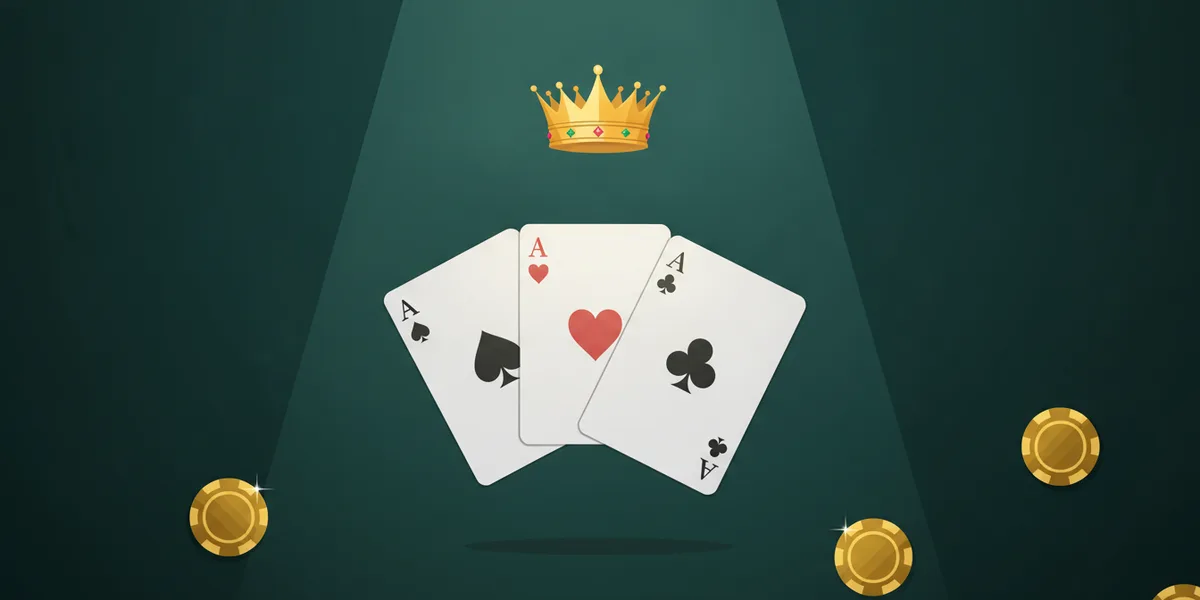
Six hand types decide every Teen Patti pot, and the whole game fits in one ladder: Trail › Pure Sequence › Sequence › Colour › Pair › High Card. Most disputes at the table aren't about that order though — they're about what happens when two players hold the same type. This guide gives you the full hierarchy, the exact tie-breaker for every rung, how rare each hand really is, and the variations that turn the ladder upside down.
The hierarchy, top to bottom — with the exact numbers
There are exactly 22,100 possible three-card hands from a 52-card deck (that is 52 choose 3). Every hand you will ever be dealt is one of them, so the frequency of each rung is not an estimate — it is a count. Here is that count, which is the part most hierarchy pages leave out:
| Rank | Hand | Also called | Example | Hands (of 22,100) | Chance | Odds |
|---|---|---|---|---|---|---|
| 1 | Trail | Set, Trio, Three of a Kind | A♠ A♥ A♣ | 52 | 0.235% | 1 in 425 |
| 2 | Pure Sequence | Straight Flush | A♥ K♥ Q♥ | 48 | 0.217% | 1 in 460 |
| 3 | Sequence | Run, Straight | 10♠ 9♥ 8♣ | 720 | 3.26% | 1 in 31 |
| 4 | Colour | Flush | J♦ 7♦ 3♦ | 1,096 | 4.96% | 1 in 20 |
| 5 | Pair | Double | K♠ K♥ 5♣ | 3,744 | 16.94% | 1 in 5.9 |
| 6 | High Card | No Pair | A♠ 9♦ 4♣ | 16,440 | 74.39% | 1 in 1.3 |
Those six numbers add up to 22,100 exactly, so you can check the arithmetic yourself. (Prefer it as a single printable page? Our Teen Patti sequence chart has the full ladder, every run in order, and a free PDF download.) Seen as a picture, the shape of the game becomes obvious:
Bar length = share of all 22,100 possible hands. The top four rungs together are under 9% of deals — which is why the game is decided by betting far more often than by cards.
The ladder is not in rarity order — and that matters
Look again at rows 1 and 2. There are 52 ways to be dealt a trail and only 48 ways to be dealt a pure sequence. The pure sequence is the rarer hand, yet every app ranks the trail above it. That is not a bug: the order is inherited from three-card brag, where it was fixed by tradition before anyone counted. It survives because changing it now would break every player's instincts.
The practical consequence is small but real: a trail is very slightly cheaper to make than a pure sequence, while paying out as the better hand. If you are ever choosing between chasing a third matching rank and chasing a suited run, the ranks are the marginally better chase — and the only rung on the whole ladder where rarity and rank disagree.
What the numbers actually mean at the table
The table above is not trivia. Read down the “chance” column and it tells you how strong your hand is relative to everyone else's, which is the only thing that matters when you decide to call, raise or fold:
- A pair already beats about 74% of all hands. Any pair. Players fold pairs constantly because a pair “feels” weak, but by frequency it is in the top quarter of the deck.
- A colour is top 9%. If you hold three of a suit, you are ahead of more than nine opponents in ten before a single card is shown.
- A sequence is top 3.7%. Against one opponent this is close to a monster. Against six it is still strong but no longer close to certain — with six opponents the chance that at least one of them beats a sequence rises sharply, and that is exactly where beginners lose big pots.
- Everything above a sequence is under 0.5%. If someone is betting hard into you and representing a trail, the prior is roughly 1 in 425 that they have one. Most of the time they are representing it, not holding it.
- Three in four hands are high card. That is the single most useful number here. Teen patti is overwhelmingly a game of weak cards, which is why blind play and pot control matter more than waiting for monsters.
Tie-breakers: same hand, who wins?
- Trail vs trail: higher rank wins — A-A-A beats K-K-K, and 2-2-2 is the weakest trail (still beats any pure sequence).
- Sequence vs sequence (pure or mixed): the higher run wins. A-K-Q is top, then A-2-3 in most apps, then K-Q-J down to 4-3-2. A pure sequence only competes against other pure sequences.
- Colour vs colour: compare highest cards; if equal, the second, then the third. Suits never break ties.
- Pair vs pair: the pair rank decides; if both hold the same pair, the third card (kicker) decides.
- High card vs high card: highest card, then second, then third. Identical ranks all the way down means a split pot in most apps.
Sideshow: where the hierarchy is used most, and explained least
A sideshow (also written side-show, or called chaal dekhna) is a private comparison. If you are a seen player, you can ask the seen player immediately before you to compare cards. They may accept or decline. If they accept, the two of you compare hands privately using the exact ladder above — and the loser folds immediately, without anyone else seeing a card. (What the request costs, and every other bet's price, is in the 3 Patti stake table.)
Three things trip people up, and none of them are in the app's help screen:
- A tie in a sideshow does not split anything. If the two hands are equal, the player who asked for the sideshow is the one who folds in most implementations. Requesting a sideshow with a hand you think is merely “equal” is a losing move — you need to be ahead, not level.
- You can only ask the player directly before you, and only if they are also seen. You cannot sideshow a blind player, and a blind player cannot request one.
- Declining is free and tells you something. A player who declines a sideshow is usually protecting a hand they do not want compared — either genuinely strong, or a bluff they do not want tested. Which one it is depends on how they have bet so far, not on the decline itself.
By contrast, a show at the end of a hand compares the last two players and is visible to the table, and there a genuine tie is normally split rather than resolved against the requester. Same ladder, different tie rule — that difference is the single most common source of “the app cheated me” complaints we see.
The one rule that genuinely differs between apps: A-2-3
Almost everything above is universal. One thing is not. The ace is used at both ends of a run — A-K-Q at the top and A-2-3 at the bottom — and apps disagree on where A-2-3 ranks:
- Most common: A-K-Q is the best run, A-2-3 is second best, then K-Q-J downwards to 4-3-2.
- Less common: A-2-3 is treated as the lowest run, below 4-3-2, on the logic that it is the smallest set of ranks.
How to check yours in 30 seconds, without risking money: open a free practice table, tap the in-game rules or help icon, and look at the sequence example list — the ordering is almost always spelled out there. If it is not, play practice hands until you see an A-2-3 reach a show. Do this once per app; it is the only hierarchy rule worth verifying yourself, and it decides real pots.
When the hierarchy flips: Muflis, AK47 and friends
- Muflis (Lowball): the entire ladder inverts — high card beats pair beats colour, and the player with the weakest normal hand wins. 5-3-2 is king.
- AK47: aces, kings, 4s and 7s act as jokers. The order stays the same, but trails and pure sequences stop being rare — fold-worthy hands change completely.
- Joker / Wild Draw: random wild cards each round; same ladder, wilder swings.
- Lowest Joker: your lowest card (all four of that rank) becomes wild — a subtle middle ground.
Full rules for each variation, with examples, are in our hands & variations guide. If you're still learning the basic flow — blind vs seen, show, sideshow — start with how to play Teen Patti, and the sister game's ladder lives in our rummy points table.