
3 Patti Rules Explained — Hands, Betting and Showdown
First, the question the spelling raises: 3 Patti and Teen Patti are the same game. “Teen” is simply Hindi for three, so 3 Patti, 3Patti, teen patti, teenpatti — and the older names Flash and Flush — all describe one game: three cards each, blind and seen betting, best hand or last nerve wins. The rules on this page are the standard game as played on Indian tables and apps, with the money mechanics — what every action actually costs — spelled out in one table, because that's the part the app help screens skip.
One game, five spellings
The spelling mostly tells you where the writer learned the game, not which game it is. “Teen Patti” is the common romanisation in India and on the big apps; “3 Patti” dominates casual search and WhatsApp; “Flash” (or Flush) is the older generation's name, borrowed straight from the British parent game three-card brag; and “Indian Poker” is what tourists call it. A couple of genuinely regional wrinkles do exist — some southern tables call a trail a “trio” and a sequence a “round”, and Gujarati home games often play the first round compulsorily blind — but they change vocabulary and etiquette, not rules. If an app markets itself with any of these names, the table you sit at plays what follows.
3 Patti game rules in eight steps
- Everyone puts the agreed ante — the boot — into the pot. The boot is the opening current stake, the number every later bet is measured against.
- Each player receives three cards face down. 3 to 6 players is standard; no jokers in the classic game.
- Starting left of the dealer and moving clockwise, each player in turn either chaals (bets to stay in) or folds (“packs”).
- You choose when — if ever — to look at your cards. Until you look you are blind and bet at half rate; after looking you are seen and pay double. The exact amounts are in the stake table below.
- A seen player may ask the seen player before them for a side show: a private comparison where the loser folds. The asked player can decline (apps usually allow two or three refusals).
- Players drop out until one player remains — they take the pot without showing — or two remain and one pays for a show.
- At the show, both hands are revealed and the higher hand under the standard order — trail, pure sequence, sequence, colour, pair, high card — takes everything. Exact ties split the pot on most tables.
- The deal passes on (or the app re-antes everyone) and the next hand starts. That's the whole loop.
If the hand order in step 7 isn't second nature yet, keep our 3 patti sequence chart open — it ranks all six hands with their real odds, lists every run from A-K-Q to 4-3-2, and downloads as a free printable PDF.
The stake table: what every action costs
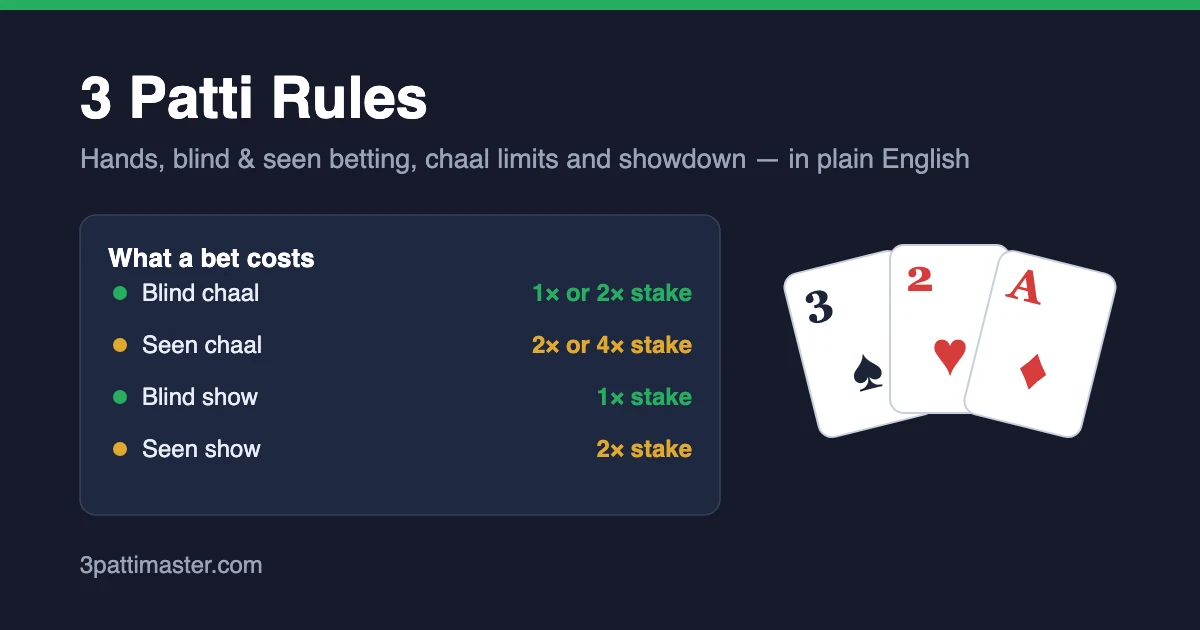
All 3 patti betting reduces to one number — the current stake — and a fixed multiplier on it. This is the entire betting rulebook:
| Action | Blind player | Seen player | Effect on current stake |
|---|---|---|---|
| Chaal (minimum) | 1× stake | 2× stake | Unchanged |
| Chaal (raise) | 2× stake | 4× stake | Doubles |
| Side show request | — not allowed — | Free with your chaal | Unchanged |
| Show (2 players left) | 1× stake | 2× stake (both seen only) | Hand ends |
| Fold | Free | Free | Unchanged |
“Stake” = the current stake, which starts equal to the boot. A blind player's bet becomes the new stake; a seen player's bet counts as double, so the stake becomes half of what they put in.
Three consequences fall straight out of this table, and they are most of 3 patti strategy:
- Seeing your cards is a purchase. The moment you look, every future chaal costs double. Good players treat the look itself as a bet: stay blind while the pot is small, look when the price of continuing matters.
- The maximum raise is a double — nothing bigger exists. No over-raise, no all-in in the standard game. Pots escalate geometrically but predictably, which is why a player who suddenly starts raising every turn is making a loud, expensive statement you should believe.
- A blind player cannot be forced to reveal. Nobody can demand a show or side show from a blind player. Blind isn't just cheaper — it's armoured, and that protection is what makes early blind play correct rather than reckless.
The hands, and the one ranking rule people misplay
Strongest to weakest: trail (three of a kind, A-A-A best), pure sequence (run in one suit), sequence (run in mixed suits), colour (one suit, no run), pair, high card (5-3-2 unsuited is the game's worst hand). Two rules settle nearly every dispute:
- Category beats cards. The lowest run (4-3-2) beats the highest colour (A♥ K♥ 9♥). Compare hand types first; only compare ranks when the types match.
- The 3 patti sequence rule: runs rank A-K-Q highest, then A-2-3 on most apps, then K-Q-J down to 4-3-2 — and the ace never wraps (K-A-2 is not a run). A minority of tables score A-2-3 lowest instead; it is the single rule worth checking in your app before real chips go in.
Every tie-breaker, the exact frequency of each hand, and the printable chart live on the sequence page; the probability analysis is in the hierarchy guide.
Showdown rules that decide arguments
- Nobody reveals for free. Cards only turn over when a show has been paid for, or inside a side show between its two participants. The winner of an uncontested pot never has to show — on apps, mucking is automatic.
- Show ties split the pot on most tables; a few award it to the player who didn't pay for the show. Side show ties are the opposite: the requester folds. Same comparison, opposite tie rule — agree both before playing at home.
- Pot-limit tables end differently. Many app tables cap the pot; when the cap is reached, all surviving hands are exposed automatically and the best one wins, no show fee required. If you play capped tables, late-hand bluffing loses most of its power — the reveal is coming regardless.
- A folded hand is dead. Fold out of turn or flash your cards at a home game and most tables rule the hand dead anyway — you cannot un-fold because the next card made it interesting.
Apps vs home games: same rules, different enforcement
Everything above applies at a kitchen table and on a phone, but the two environments enforce it differently, and knowing which dial the app has already set saves confusion:
- Apps enforce the stake maths for you. The buttons only offer legal amounts, which is why players who learned on apps often can't say why a seen chaal cost what it did. At a home game, you are the calculator — the table above is the audit trail.
- Apps time you out; homes talk you out. Most tables give 15-30 seconds per turn and fold you (or auto-chaal the minimum) when it lapses. Home games have no clock, which is exactly why they need the house rules below agreed in advance.
- Boot and limits are fixed per table on apps. You choose the stakes by choosing the table, not by negotiation — and the pot cap that ends big hands automatically is an app invention that home games don't use.
- Shuffling is the app's certified RNG. No cut, no deal rotation, no dealer advantage — which removes the most common home-game suspicion but adds a different one; how we evaluate an app's fairness and licensing is part of our rating method.
House rules to settle before the first deal
The classic game leaves a few dials for the table to set, and every long-running argument we've seen traces back to one of them: how many blind chaals are allowed before you must see (apps commonly force it around the fourth), whether A-2-3 plays high or low, how many side show refusals are permitted, whether show ties split, and the boot size relative to everyone's stack. Asking five questions before the first deal is faster than one argument during the fifth hand. For the full walk-through of a betting round — with four example hands and the pot counted rupee by rupee — see the complete Teen Patti rules guide; for how Muflis, AK47 and joker games bend these rules, the variations guide has each one with examples.